Winter Solstice


 NEW WORK
Sacred Datura


 COLLECTION
 Field of Flowers


   COLLECTION  
Time & Place
Ancient Sun
In the Garden of the Night


 ART FOR THE
 FLOOR
dressed loom


 THE WEAVING


THE ARTIST 
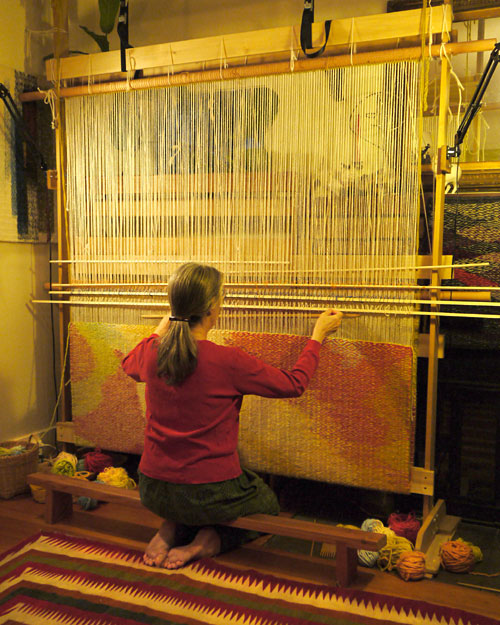
Stephanie weaving


CONTACT US
LINKS 
SnapDragons


Stephanie T. Hoppe, Handwoven Wool Rugs


ANCIENT TECHNIQUES
CONTEMPORARY DESIGN


More than 1,200 years ago, the people of the American Southwest perfected the vertical loom and weaving techniques I use today. With finished selvages on all four sides of each piece, I can pack the weft yarn tightly so the rug will withstand hard wear on the floor.

I dye the wool yarns I use for weft with modern washfast, lightfast “acid” dyes (the acid I use to fix the dye is ordinary household; vinegar). These dyes give me a wide range of rich colors with minimal environmental impacts.

I design my weavings with a view to their being used as rugs lying on the floor, but they can also be enjoyed as tapestries hung on the wall
.


FREQUENTLY ASKED QUESTIONS

What is special about these rugs and tapestries?

The weaving technique with finished edges on all four sides ensures a very tight, dense weave that makes the finished piece both soft and lustrous to the touch and long wearing in daily use as a rug. Because of the continuous warp, these weavings lack loose fringes or hems. The corner tassels might be called “memories of the loom,” as they are tied from the ends of the twining cords used to fix the warp to the loom frame. Depending on the design and the purchaser's needs, any of the weavings can be used as wall-hung tapestries.

How and where are these rugs and tapestries made?
All the work is done by me personally, in my studio at my home in Ukiah, California. I purchase natural white and gray spun yarn in large skeins, dye it in one-pound lots or “paint” it with dyes for a variegated effect, wind the warps, weave, and steam and block the finished pieces. For  details, see THE WEAVING.

How safe are the dyes for purchasers or the environment? How durable are they?
The dyes are set  by heating them in a dilute mixture of ordinary household vinegar (pH 4.5 to 5.5). This process permanently attaches the dye molecules to the fiber molecules, so these dyes have good washfastness and lightfastness. This means the dyes do not come out of the yarn, so they cannot harm the user. All coloring of clothing, bedding, other textiles and household items involves some use of chemicals that can be harmful if not properly used. The dyes I use are designed to be measured carefully so that all the dye in a dyebath is absorbed by the yarn and none is left over.

How do I care for or clean these rugs?
Vacuuming generally suffices for ordinary cleaning. Most spills and spot stains can be removed by blotting with dishwashing liquid and clean water or soda water. More thorough cleaning can be done by a dry cleaner or by laying the rug flat on a deck or piece of clean plastic and washing with wool soap and cold water, then hanging over a railing to dry. For more details see ART FOR THE FLOOR.

How can I see or purchase one of these rugs?
The rugs can be seen at shows and galleries. I also welcome visitors to my studio in scenic Mendocino County. If you live in the San Francisco Bay Area or points north, I can bring samples for you to see in your home or office. For contact information and show schedule, see CONTACT US.